


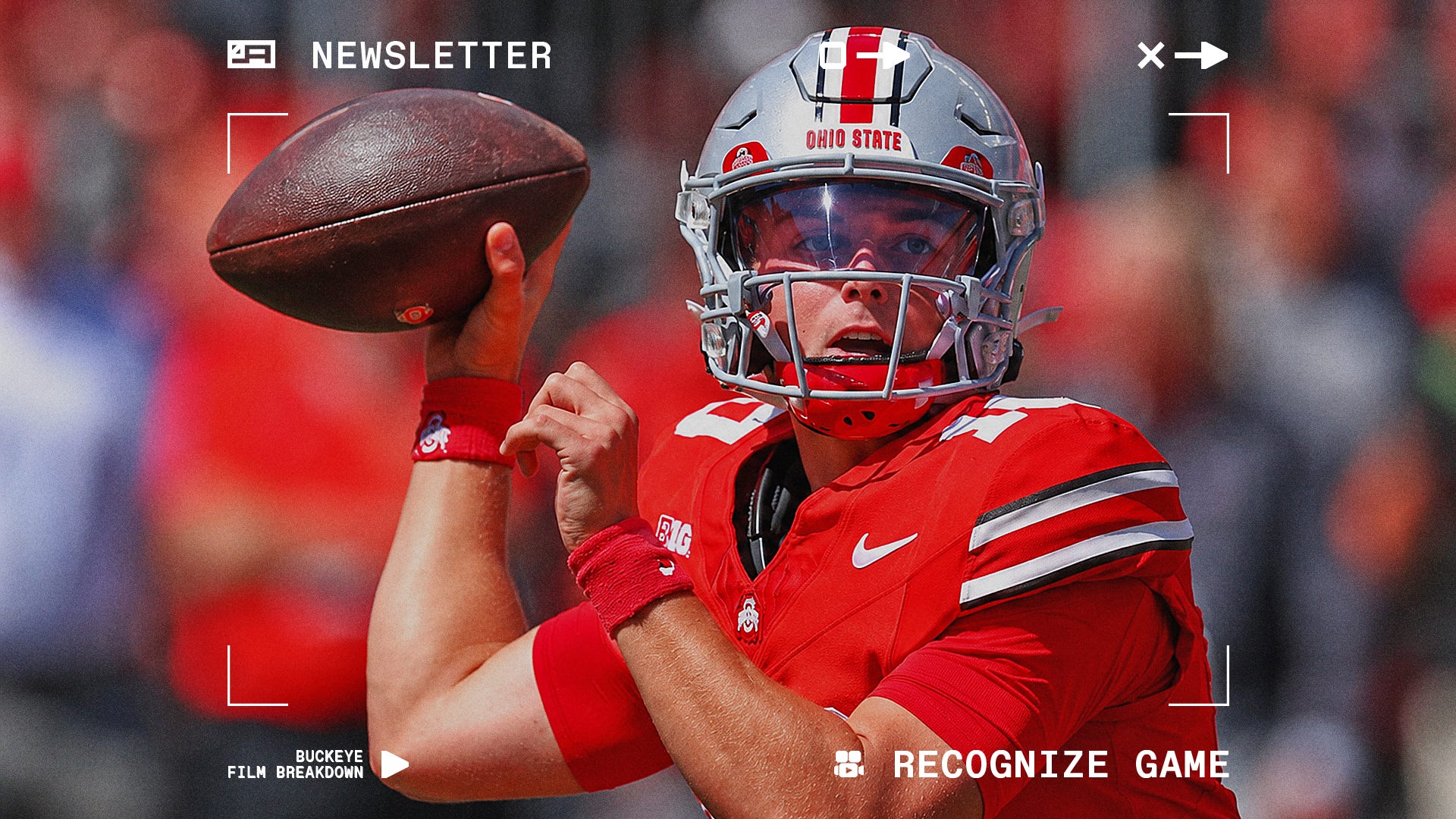
Earlier this week, we talked about what Arthur Smith is bringing to the Ohio State Buckeyes football offense—specifically in the play-action game and the ability to generate explosives downfield. That conversation matters more when you can tie it to a real moment.
And fittingly, this one showed up right away—on the opening drive of the season.
The Situation
Ohio State opened the game with a clear intent: establish the run and set the tone physically. You saw it immediately with Counter, Duo, and Inside Zone—calls designed to create movement, test the front, and force the defense to commit numbers early. But on 3rd and 1, they come up short.
Now the moment shifts.
After a defensive stop, this is a possession where finishing matters. Coach Ryan Day has been consistent about starting fast, and this is one of those early opportunities to take control of the game. Instead, the Buckeyes find themselves in 4th and short in plus territory—one of the most telling situations for offensive identity.
Because in this moment, defenses are conditioned to expect run.
The Call
Rather than play into that expectation, Ohio State takes a calculated shot.
This is where the influence of Arthur Smith shows up. In 4th and short situations—especially 1 yard or less—defenses naturally compress. Safeties become more aggressive, second-level defenders step downhill, and corners anticipate quick-game or run support. That creates a window.
If you can sell the run effectively, there’s an opportunity to attack vertically—and with a player like Jeremiah Smith, that’s a chance you take.
But it has to be precise. The quarterback has to sell the fake. The running back has to commit to it. And the receiver has to win his route. All three pieces have to align.
LATEST PODCASTS:
LATEST ARTICLES:
LATEST FILM ROOM:

The Design
The structure of the play reflects exactly what you want from a play-action shot. It’s built as a high-to-low progression, starting with Jeremiah Smith on the post and working back to the dig from Max Klare.
The intent is clear: influence the safety, create a one-on-one vertical opportunity, and open the intermediate window behind it. If the safety steps down—which he’s expected to do in this situation—the post is live. If that’s taken away, the dig becomes the answer.
And more often than not, that dig is open.
It’s a clean, layered concept designed to stress the defense at multiple levels.
What Happens
At the snap, the execution starts exactly how you draw it up.
Julian Sayin delivers an exceptional ball fake, one that pulls the safety down into the box quicker than he likely wants. That’s the trigger. That’s the conflict the play is designed to create.
Jeremiah Smith gets the look you want—one-on-one on the post.
But this is where experience shows up.
Rather than holding on the vertical and trusting the shot, Sayin works through the progression quickly and comes down to the dig. It’s not the wrong read within the structure—it’s just earlier than the design ideally calls for.
And to his credit, the throw is elite.
He puts the ball exactly where it needs to be.
Klare is open.
And the ball is dropped.
Why It Matters
On the surface, it’s an incomplete pass on 4th down.
But that doesn’t tell the full story.
What matters is what the play reveals. The Buckeyes didn’t approach the moment conservatively—they attacked it. They trusted the design, leaned into play action, and created exactly what they wanted: a stressed defense and a defined opportunity.
Everything about the structure worked:
The fake created movement
The safety was influenced
The progression developed cleanly
The secondary option was there
That’s winning football from a design standpoint.
Now it becomes about growth—trusting the progression, allowing the shot to develop, and finishing when the opportunity presents itself.
Final Thoughts
Not every well-designed play results in production.
But this one shows exactly where this offense is headed.
Aggressive.
Layered.
Built to create explosives.
On the opening drive of the season, Ohio State didn’t ease into it—they took a shot.
And even though it didn’t hit, it tells you everything about the identity being built under Arthur Smith.
The opportunities are there.
Now it’s about capitalizing on them.
Buckeye Film Breakdown will return soon with some fresh content.
