


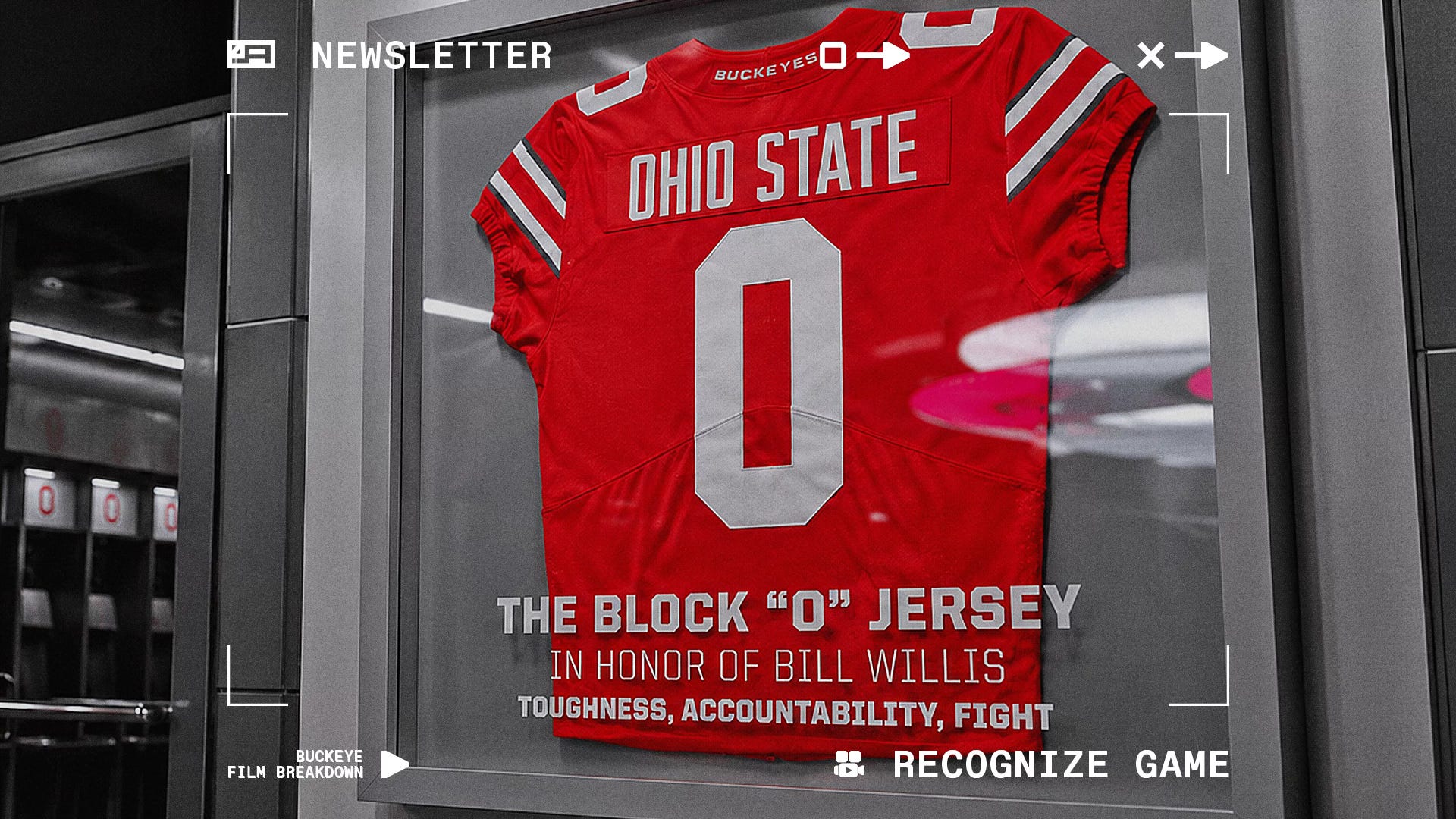
At Ohio State, the Block “O” may be a newer tradition, but it’s rooted in something much older.
Introduced in 2020 and inspired by Buckeye legend Bill Willis, the honor represents toughness, accountability, and leadership. It’s not tied to position or stat lines—it’s about who the program trusts to represent its identity every day.
Since its inception, it’s been worn by players like Jonathon Cooper, Thayer Munford, Kamryn Babb, Xavier Johnson, Cody Simon, and Sonny Styles—players whose paths were different, but whose presence inside the program was the same.
That’s the standard.
And heading into 2026, the question isn’t just who produces.
It’s who represents it.
Defensive End, Kenyatta Jackson Jr.
Jackson’s leadership profile is built on development and accountability within the structure of the defense. As a former highly rated recruit, the expectation early was tied to his physical traits. What’s emerged instead is a player who understands how to operate within the system—setting edges, maintaining leverage, and executing his assignment consistently.
That matters up front, where one breakdown can compromise the entire defense. Coaches consistently emphasize defensive linemen who “play within the defense” as tone-setters, and Jackson is trending in that direction. His leadership isn’t loud—it’s functional. It shows up in alignment, effort, and trust. The kind of player others can rely on to do his job the right way, every snap.
Wide Receiver, Brandon Inniss
Inniss brings leadership (Returning Captain and Iron Buckeye) through competitiveness and physical accountability. Since arriving as a 5-star, his development hasn’t just been about playmaking—it’s been about embracing the full responsibility of the position.
That includes blocking, finishing plays, and competing in the run game—areas that define trust within a receiver room. Coaches consistently highlight players who handle the “dirty work” as tone-setters, and Inniss fits that profile. His leadership shows up in how he plays without the ball, which carries weight internally.
It’s visible. It’s repeatable. And it raises the standard for everyone in the room.
Offensive Guard, Luke Montgomery
Montgomery’s leadership is rooted in consistency, versatility, and presence within the offensive line. His development across multiple positions has built trust—something that matters in a room defined by communication and cohesion.
And I’ll be upfront—knowing Luke personally, there’s some bias. But there’s also perspective. The leader he’s developed into aligns directly with what the Block “O” represents. It’s not surface-level. It’s built through daily habits, accountability, and how he approaches the work.
Offensive line leadership isn’t loud—it’s steady. It shows up in preparation, communication, and how the group responds under pressure. Montgomery fits that mold. And that’s what earns respect inside the building.
Center, Carson Hinzman
Hinzman’s leadership is tied to experience and command of the offense. Playing center requires control—of protections, of fronts, and of communication pre-snap. It’s a position that demands trust, and that trust is built over time.
His path has included both growth and adversity, and that’s where credibility comes from. Players respect experience when it’s paired with development, and Hinzman has continued to build both. Coaches consistently emphasize the center as a leader within the offense, and his role reflects that.
His leadership shows up before the snap—getting the offense aligned, communicating clearly, and ensuring everyone is operating on the same page.
LATEST PODCASTS:
LATEST ARTICLES:
LATEST FILM ROOM:

Dark Horse: Tight End, Bennett Christian
Christian’s case is built on growth—and that’s what makes him different.
Early in his career, he faced adversity with a suspension that could’ve easily knocked him off track. For a lot of players, that becomes a turning point in the wrong direction. For Christian, it became a reset point. He stayed in it, handled it the right way internally, and worked his way back into the program.
That matters in a building like Ohio State. Players notice who responds the right way when things don’t go as planned.
Since then, his development has been tied to embracing his role. The tight end position in this system isn’t built on touches—it’s built on trust. Blocking on the edge, handling physical assignments, and being reliable in key situations. Christian has leaned into that, and that’s where his value shows up.
Leadership in this context isn’t about being the loudest voice—it’s about consistency after adversity. It’s about sticking it out, doing the work, and earning your way back into trust within the program.
That’s why he fits as a dark horse.
Final Thoughts
The Block “O” has followed a clear pattern since its introduction—but it’s not about performance.
It’s about representation.
It shows up in different ways depending on the player:
Defensive linemen who play within structure and set the tone
Skill players who bring toughness and accountability to every rep
Offensive linemen who lead through communication and consistency
And players who earn trust through how they respond to adversity
Kenyatta Jackson Jr., Brandon Inniss, Luke Montgomery, and Carson Hinzman each bring a version of that standard—how they work, how they prepare, and how they carry themselves inside the program.
And then there’s Bennett Christian, whose path reinforces what this honor is really about. Growth, accountability, and response when things don’t go as planned—that’s part of representing the program the right way.
That’s the separator.
The Block “O” isn’t given to the best player.
It’s given to the one who best represents Ohio State.

Buckeye Film Breakdown will return soon with some fresh content.
